As a member of the ATLAS Collaboration, doctoral students are generally required to perform a Qualification Task (QT), which is a year-long project dedicated to the overall operations, maintenance, or future success of the experiment, which is rewarded by receiving authorship status upon completion. This is the collaboration's way of managing the politics of academic authorship in an experiment shared by over 5,000 collaborators which publishes hundreds of papers each year.
My own QT focused on mapping the toroidal magnetic fields used for the ATLAS Muon Spectrometer, which I completed in the second year of my PhD. This page presents an overview of the details associated with my project, aimed at an audience with less exposure to collider experiments.
Rather than detail the specific results from my project which are largely internal, this page presents an overview the general purpose and design behind ATLAS' magnetic fields, their role experiments, and the associated challenges for this goal addressed by my QT.
In collider physics, one of the most important observables for event reconstruction is the momenta of particles produced in our collisions. Combining these momentum measurements with energy deposits and spatial information from other detector components helps us develop a full kinematic picture of our collision, enabling us to perform the precision measurements which drive particle physics forward.
In most modern detectors, this momentum information is obtained for charged particles by exploiting the fact that they arc when traveling through a magnetic field. By placing our particle detector components within a strong magnetic field, we can derive the momentum of charged particles as a function of the field strength and the radius of curvature (specifically a quantity known as the sagitta).
Implementing this method in practice is met with increasingly levels of complexity, with the initial challenge being posed by the difficulty of creating a uniform magnetic field across a wide region of space, a notable concern for the 22,000 m³ ATLAS detector. Instead of relying on a single magnetic field source, ATLAS uses an open air solenoid as well as three different toroidal magnets, one in the central region of the detector (known as the barrel) and one in each of the end caps of the detector.
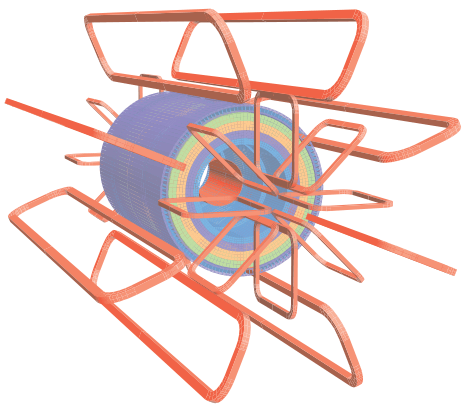
Schematic of the ATLAS magnetic field sources (shown in orange), including the toroidal coils and inner solenoid, which is shown immersed in the calorimeters. Sourced from CDS.
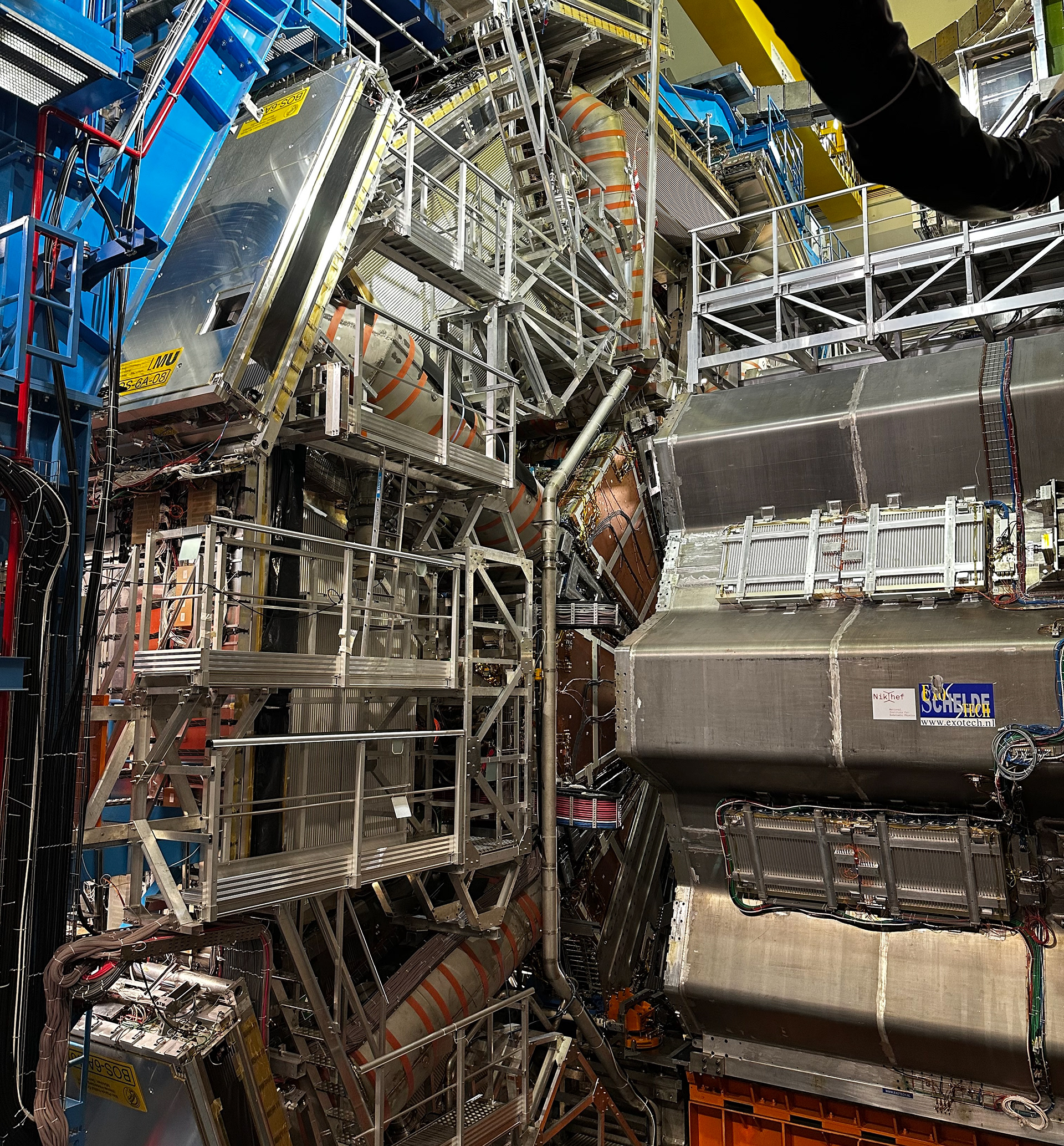
My own picture of the ATLAS detector in early 2026. The gray end cap toroid is easily visible in its retracted position, with the barrel toroidal coils being identified by the orange heating fixtures.
The solenoid magnet is the simplest of the bunch, providing a fairly uniform 2 Tesla magnetic field for the inner detector to track charged particle trajectories.
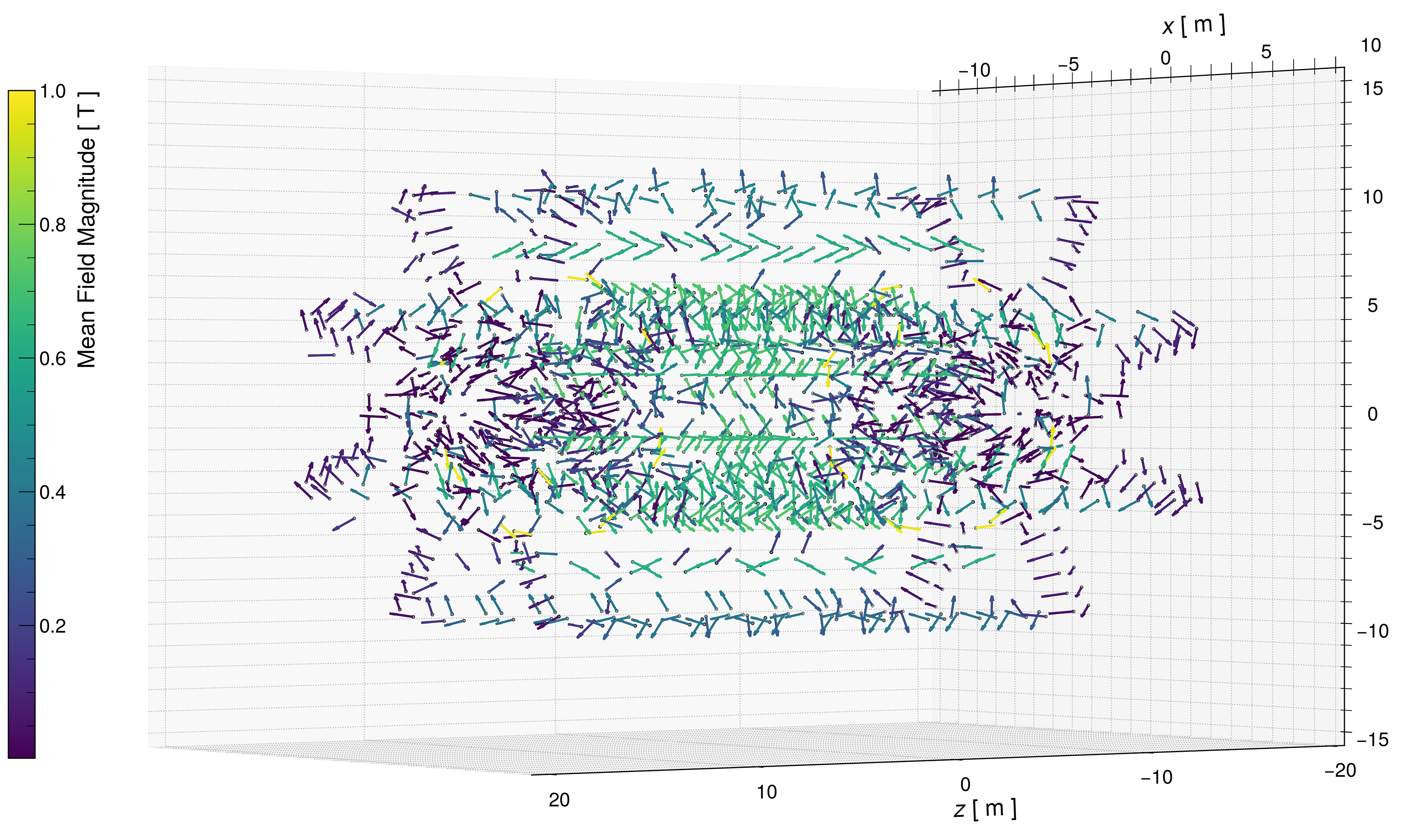
Magnetic field readings from Hall sensors located across the ATLAS detector
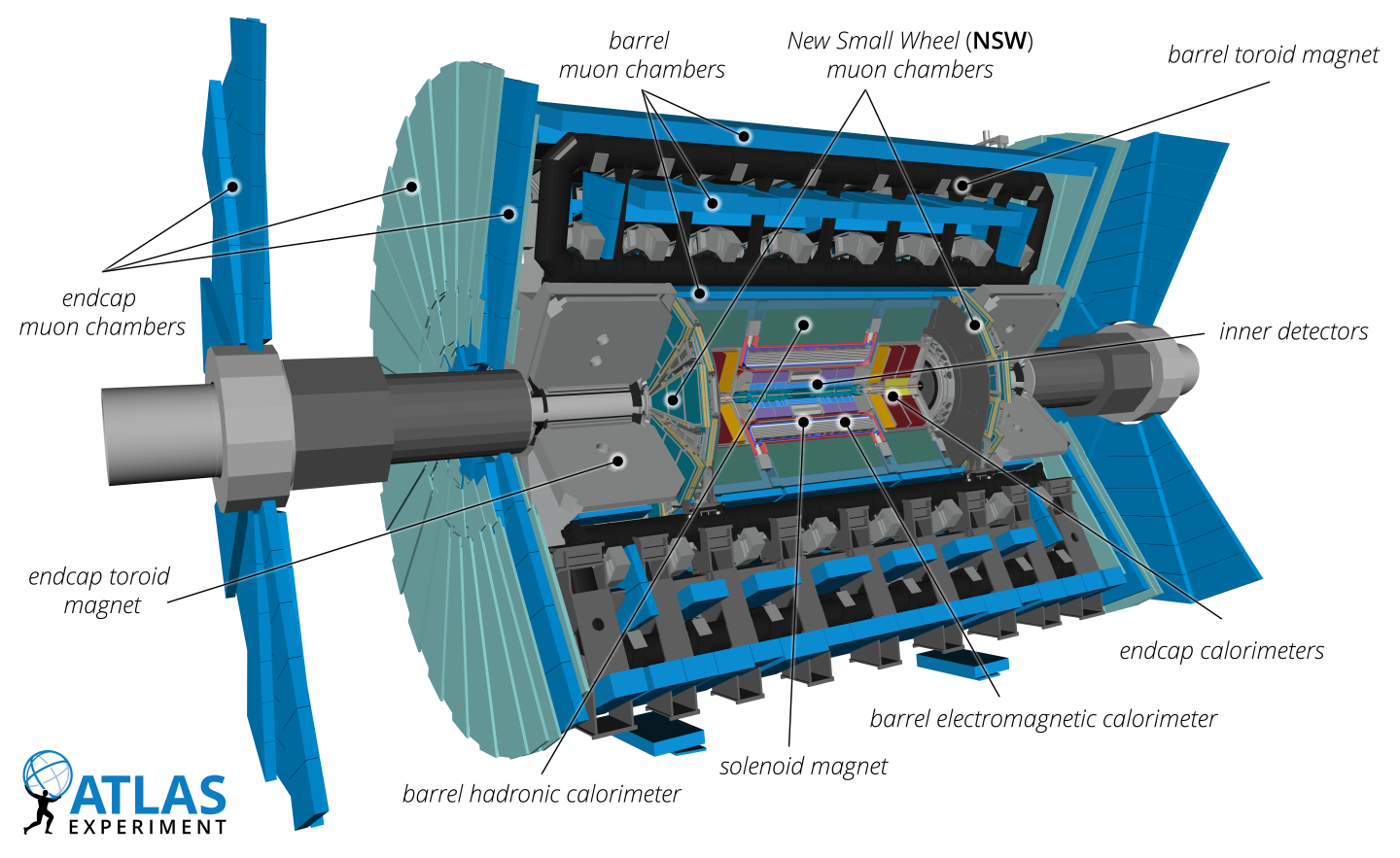
Schematic of ATLAS detector and key components, sourced from CDS